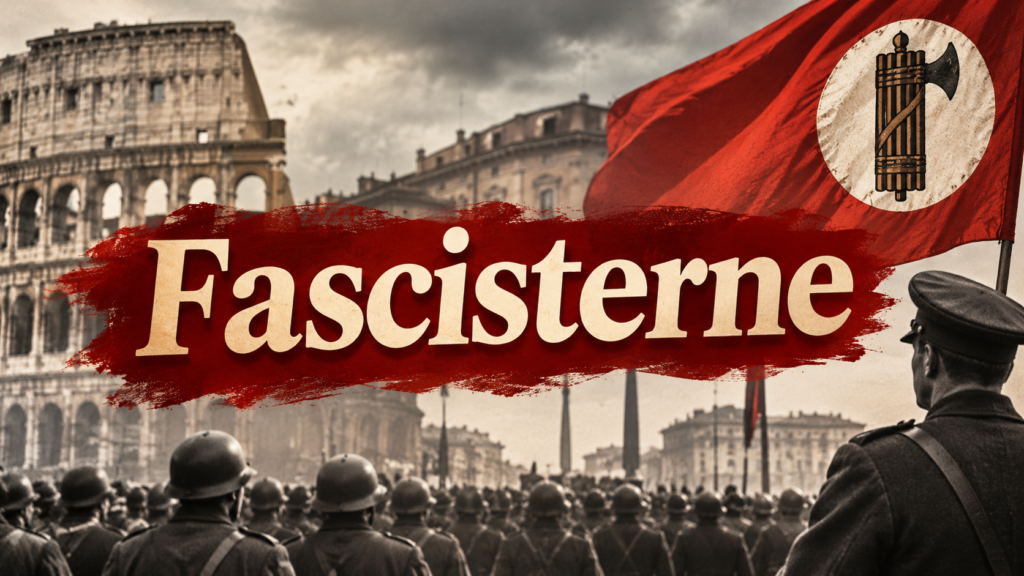
The word Fascisterne is Danish and translates into English as “the fascists.” It refers to people who support or belong to fascist political movements. Although the word has historical roots in twentieth-century Europe, its meaning remains important when discussing politics, democracy, nationalism, and human rights today.
But who were the fascists? Where did their movement begin, and why did it become such a powerful force in European history? Understanding these questions helps explain one of the most significant political developments of the modern era.
What Does Fascisterne Mean?
In Danish, Fascisterne is the definite plural form of fascist. It describes individuals who follow fascism, an authoritarian political ideology built around extreme nationalism, centralized leadership, and strong state control.
Fascist movements generally promote the idea that national interests should come before individual freedoms. They often reject political opposition, independent institutions, and democratic competition.
The term is closely connected with the history of Italy under Benito Mussolini and Germany under Adolf Hitler. However, fascist organizations also appeared in several other European countries.
Where Did Fascism Begin?
Fascism developed in Europe during the early twentieth century. The First World War had left many countries struggling with economic problems, political instability, unemployment, and social divisions.
Italy became the birthplace of organized fascism. In 1919, Benito Mussolini established the Fasci Italiani di Combattimento, a movement that eventually developed into the National Fascist Party.
Mussolini promised national strength, order, and a return to greatness. His message attracted supporters who were frustrated with existing political institutions.
In October 1922, the March on Rome helped Mussolini secure the position of prime minister. He gradually transformed Italy into a dictatorship, restricting opposition and concentrating political power.
Germany later experienced another major fascist movement under Adolf Hitler and the Nazi Party. After Hitler became chancellor in 1933, democratic institutions were dismantled and Nazi control expanded throughout German society.
Main Characteristics of Fascist Movements
Although fascist movements differed between countries, several characteristics appeared repeatedly.
- Extreme nationalism: The nation is presented as more important than individual interests.
- Authoritarian leadership: Political power is concentrated around one dominant leader.
- Suppression of opposition: Critics, political opponents, and independent organizations face intimidation or persecution.
- Militarism: Military strength and discipline are celebrated as signs of national power.
- Propaganda: Governments use controlled media and public messaging to influence citizens.
- Discrimination: Certain racial, religious, ethnic, or political groups may be portrayed as enemies.
- Rejection of democracy: Independent political competition and democratic freedoms are weakened or eliminated.
These characteristics help historians understand how fascist governments gained influence and maintained control.
Fascisterne and the History of Denmark
The keyword Fascisterne also has an interesting connection with Danish history.
During the 1920s and 1930s, fascist and national socialist movements appeared in Denmark. One of the most important organizations was the National Socialist Workers’ Party of Denmark, commonly known as DNSAP.
Founded in 1930, DNSAP was strongly influenced by Adolf Hitler’s Nazi Party. Its political ideas included nationalism, antisemitism, and opposition to parliamentary democracy.
Frits Clausen became the party’s leader in 1933. Despite its organizational growth, DNSAP never achieved widespread electoral support comparable to the major political parties in Denmark.
During the German occupation of Denmark in the Second World War, the party attempted to increase its influence. However, it never became the country’s governing authority. Following Germany’s defeat in 1945, DNSAP dissolved.
This part of Danish history shows that fascist movements existed beyond Italy and Germany, even in countries where they failed to gain significant political power.
Fascism Compared With Democracy
Understanding the differences between fascism and democracy makes the historical discussion easier.
| Political feature | Fascism | Democracy |
|---|---|---|
| Leadership | Authoritarian leader | Elected representatives |
| Political opposition | Often suppressed | Legally protected |
| Individual rights | Subordinated to the state | Protected by law |
| Media | Often controlled | Independent media encouraged |
| Elections | Restricted or manipulated | Competitive elections |
| National identity | Often exclusionary | Equal citizenship is a democratic principle |
The table highlights why fascist systems are considered a serious threat to democratic institutions.
Why Is Understanding Fascisterne Important Today?
Studying fascisterne is not simply about remembering historical events. It also provides an opportunity to understand how political extremism develops.
History demonstrates that authoritarian movements can gain support during periods of uncertainty. Economic hardship, social conflict, national humiliation, and distrust in established institutions can create opportunities for extremist political groups.
Propaganda can make complicated problems appear simple by blaming particular communities or political opponents. Gradually, this approach can weaken public trust and encourage hostility.
Recognizing these patterns matters. A society that values open discussion, independent journalism, fair elections, and equal rights has stronger protections against authoritarian rule.
Final Thoughts
Fascisterne is more than a Danish vocabulary word. It connects to a major chapter of European history involving dictatorship, political violence, nationalism, and the destruction of democratic freedoms.
From Mussolini’s Italy to Hitler’s Germany and the Danish DNSAP movement, fascism left a lasting mark on the twentieth century.
Learning about these movements helps readers understand the importance of democracy, historical awareness, and individual rights. And perhaps the most important lesson is that protecting democratic values requires attention, knowledge, and responsibility from every generation.